Showing posts with label health. Show all posts

Tuesday, 3 July 2007

A GLIMPSE OF THE FUTURE?

anticant writes:

I returned home yesterday after a week as an inpatient in my local Marie Curie Hospice. I went there because the previous week I had an investigative ‘procedure’ at the nearby hospital which left me with a bladder infection – so much for the vaunted NHS clean-up of hospital bugs! I felt so poorly and washed out the following weekend that I knew I needed a few days’ nursing care. So I phoned the hospice – whIch I visit most weeks as a day patient – and asked whether they could take me in. Within the hour, they replied saying “yes – come along”. So I have spent the last week being dosed with antibiotics and recovering from my painful condition in unexpectedly pleasant surroundings.

Not having been an inpatient before, I was unsure as to how the hospice would compare with the several hospitals where I have been a patient over the past couple of years. I need not have worried – there is no comparison. The hospice is staffed by highly skilled and genuinely friendly staff, and equipped to a standard that you don’t find in most other medical establishments. It’s like a hotel with nursing; there are comfortable sitting rooms for patients who can walk about and their families, and a [highly alcoholic] free drinks trolley, provided by the Friends of the hospice, comes around most days – so I was able to celebrate the departure of the ghastly Blair with a large brandy!

Routine and discipline are at a minimum, and necessary tasks such as washing and the administration of medicines are carried out in a friendly, informal way. Nothing is too much trouble for the staff, who are dedicated to making life as comfortable as possible for patients however ill they are. Of course, there is a sad side in that many of the patients are extremely ill and indeed dying – there was at least one death while I was there. But I cannot imagine a more supportive, friendly, and indeed cheerful, place in which to be terminally ill and to die, and I hope that it will be my last port of call in due course.

Marie Curie Cancer Care is a charity heavily dependent on voluntary funding, and I earnestly commend it to all my blogging friends who want to donate to a charity that they can be assured will use their money wisely and well.

I’m pleased to say that after my week’s ‘rest’ I feel much better and ready to resume the threads of what’s left of my life. I also feel much more secure about the future.

Friday, 20 April 2007

NOT ONE OF MY BEST

anticant writes: I awoke at 4am with a recurrence of kidney pains - not as acute as previously, thank goodness, but bad enough to necessitate spending most of the day in Outpatients, attended by the faithfully patient ben, where they diagnosed another [new?] stone wending its way down from my left kidney through my bladder to the long-suffering exit. A tedious waste of a lovely day, not improved by the mental mayhem and nausea induced by necessary but nasty pain killers.

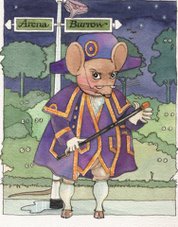
Back at the burrow, the Beadle anxiously spring-cleaned the Snug, polishing the brassware to a new level of mirror-shininess, and creating a place of honour over the bar anticipating the arrival of his definitive image now being crafted by burrow portraitist [By Appointment] Miss lavenderblue.

Let's hope the fine weather forecast for the coming weekend will bring a finer state of health for the currently somewhat fragile anticant.

Sunday, 11 March 2007

FULL CIRCLE

I came home yesterday after a couple of nights’ stay in the Royal Free, Hampstead, under observation for what turned out to be three small kidney stones – fortunately too small to require surgery. Even so, they were big enough to cause me several hours of excruciating agony until my GP gave me a pain-killing injection.

I was kept in overnight for further scans and tests, and was fascinated to find myself in the “George Qvist Ward”. This brought back vivid memories of the ‘near miss’ I had over thirty years ago, when my appendix burst just before Christmas and I was only saved by emergency major surgery performed by the very same George Qvist. George Qvist [pronounced “Kwist”], 1910-81, was a senior surgeon at the Royal Free Hospital, and my operation in fact took place at the old hospital in Grays Inn Road because the new one in Hampstead was still under construction and Mr Qvist preferred to use his familiar theatre at the old site. So I was one of the last patients there, being in for six weeks because the operation had to be repeated when an abscess formed.

I have always counted Mr Qvist as the bestower of the remainder of my life since then, and it was curious to renew the link with him this week. As he has been dead for over quarter of a century, the young ward staff regarded me as somewhat of an antique when I told them about my personal contact with him.

How the wheel of life spins!

That’s enough about me. Has anyone any news of Zola?

Saturday, 9 December 2006

THE WICKEDNESS OF DENIAL

When I posted a little moan about all the hours we chronically ill are obliged to waste in hospital outpatient departments, I did not anticipate that I would become embroiled in a surrealistic discussion about whether illness is ‘real’, or just a symptom of “wrong thinking”. But so it happened, with repercussions both here and on Big Pike’s site which I expect a good many of you will have seen.

This has led me to reflect on the phenomenon of denial, which is an increasing feature of our contemporary mental climate. By denial I mean the refusal, by individuals, organisations, and sometimes governments, to accept what stares them in the face. This discounting of obvious states of affairs, and of the consequences of the deniers’ actions, is not merely dangerous folly: in my opinion it is often dangerous wickedness and morally culpable.

An obvious example is the Bush/Blair refusal to accept that the invasion of Iraq was a disastrous mistake, and has caused perhaps irreparable damage not only to that unfortunate country but to the cause which our leaders profess to serve.

Another is the Vatican’s stubborn refusal to accept that the use of condoms could save many millions of lives.

A third is the refusal of many vocal Muslims to understand that if they wish to be accepted by the non-Muslim population of this country as friendly neighbours, they must abide by our common democratic values, and cease demanding special privileges for their religion such as the introduction of sharia law. Thank goodness that Tony Blair has at long last shown a grain of sense in starting to tell them this. Not before time!

While I have no business to deny the personal reality of someone who believes they are “saved” because of their belief in a Deity, although I may consider that they are sadly deluded, where the denial of the physical reality of illness on the spurious ground that it is “all in the mind” and can be cured by “a change in thinking” is concerned, I think that I can legitimately say on the basis of my own life-experience and that of countless others that this contention is claptrap. It is a belief that does not stand up against the visible evidence, and can only be adhered to by someone with a stubborn belief in verbal somersaults and empty paradox.

To bolster my case, I cite the following examples:

My own. I have been seriously ill for two years now. I am only too well aware of the importance of mobilising whatever mental strength I am capable of in living as creatively as possible with my illness, but I know that it will never be cured by a “change in thinking”.

My grandfather suffered from a serious depressive illness for twelve years, and unavailingly sought for every possible cure on offer. He ended up, thanks to medical mismanagement, as a bad case of drug dependency. He would not have been cured by a “change of thinking”.

A year ago some cousins lost a grandchild who died a week after his first birthday. The poor infant had been diagnosed with liver cancer at four months, and during the remainder of his short life his family underwent great stress which traumatised them and will continue to do so for a long while. Could this tragedy have been averted by a “change of thinking” on the part of this little baby or his parents?

A lifelong friend who died not long ago aged 80 had suffered throughout his life from the effects of being born with a cleft palate. Repeated operations and other painful treatments dogged him throughout his life. Nevertheless, he bravely pursued an academic career and became a distinguished Professor in his field. Could his physical disability have been cured by a “change of thinking”?

I could go on, but I rest my case. By all means let us have free and controversial discussion amongst the posters and commentators of the Awkward Squad. But not houseroom for arrant nonsense, please.

Monday, 4 December 2006

PATIENTS NEED PATIENCE

Susan Sontag opens her luminous essay Illness as Metaphor by observing that “Illness is the night-side of life, a more onerous citizenship. Everyone who is born holds dual citizenship, in the kingdom of the well and in the kingdom of the sick. Although we all prefer to use only the good passport, sooner or later each of us is obliged, at least for a spell, to identify ourselves as citizens of that other place.”

For the past two years I have inhabited that other place. It’s not my intention to write at length, or frequently, about my disease – Angela does that so admirably in her site – but there are a few messages I’d like to pass back to those of you who still inhabit the sunnier side.

Chronic illness completely takes over your life. You don’t realise it at first – you expect that, as with previous episodes, your indisposition will pass and you will resume normal existence. My travails started with a persistent and exhausting chest infection which I only discovered, far too late, had been undiagnosed pneumonia. As a result, I spent about four months, on and off, as a hospital inpatient – including two or three weeks in intensive care – and am now a regular outpatient for ongoing observation, and if necessary further treatment, of this condition and also at another hospital for leukaemia, which was diagnosed while I was an in-patient.

The standard of medical care which has been lavished on me by my NHS consultants and their teams is superb and beyond praise. But it is the whole business of being an outpatient which I find increasingly tedious and burdensome. Fortunately, my two hospitals are close to one another, but in a distant part of London. So my visits to them involve lengthy journeys both ways by taxi [subsidised by London government, thank goodness] in addition to the time spent at hospital, which can be anything between two and three or more hours. Today, I had to visit both, and was out of the house for six hours, returning feeling pretty exhausted after having two blood samples taken and being given three injections.

What is irksome above all is the waiting. Patients do indeed have to be patient, and their partners or companions have to be even more patient. We have to arrive at least half an hour before my appointment time in order for me to give a blood sample, after which we wait, in company with many other patient patients and their supporters, for the doctors. They are usually running something like an hour late. That is not their fault and I do not blame them – I would far rather they were doing their job thoroughly and giving each patient adequate time, which they do, than that they were skimping and rushing to keep up with a timetable.

But it’s all pretty wearisome, and I shall have to go on enduring it for the rest of my life, so far as I can see. I hope that none of you ever find yourselves in similar situations.