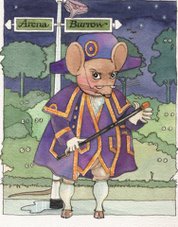
The Beadle - who has smatterings of culture - waxes philosophical:
Werner Heisenberg is out driving when he's stopped by a motorcycle cop.
"Do you know how fast you were going?" asks the cop.
"No, but I know where I am", Heisenberg replies.
René Descartes is drinking in a bar in Paris:
"Another one, René?", asks the barman.
"I think not", says Descartes ... and immediately vanishes.
Showing posts with label philosophy. Show all posts
Showing posts with label philosophy. Show all posts
Wednesday, 4 April 2007

Monday, 19 March 2007
SNUG PHILOSOPHY
With all the high-grade cerebration displayed by Toby, Zola, YD and other bloggers, ben and the beadle have decided to institute their own "Introduction to the Burrow School of Philosophy" in the Snug. A foaming tankard will be awarded to the candidate offering the most enlightening observations upon the following:
Do infants enjoy infancy as much as adults enjoy adultery?
If a pig loses its voice, is it disgruntled?
Why is the man who invests all your money called a broker?
When cheese gets its picture taken, what does it say?
Why is a person who plays the piano called a pianist but a person who drives a race car not called a racist?
Why are a wise man and a wise guy opposites?
Why do overlook and oversee mean opposite things?
"I am" is reportedly the shortest sentence in the English language. Could it be that "I do" is the longest sentence?
If lawyers are disbarred and clergymen defrocked, doesn't it follow that electricians can be delighted, musicians denoted, cowboys deranged, models deposed, tree surgeons debarked, and dry cleaners depressed?
Ever wonder about people who spend £2 on those little bottles of Evian water? Try spelling Evian backwards.
Isn't making a smoking section in a restaurant like making a peeing section in a swimming pool?
If 4 out of 5 people SUFFER from diarrhoea. Does that mean that one enjoys it?
WARNING: the beadle has orders to deflate candidates whose entries are too clever by half.
Monday, 12 February 2007
BEECHAM MEMORIES
I only once heard the great Sir Thomas Beecham conduct. It was with his own orchestra, the Royal Philharmonic, at the recently built Royal Festival Hall which Sir Thomas had at first scorned as “a disused mining shack in Nevada: frivolous and acoustically imperfect”. The latter part of this judgement was certainly correct, and it took some time to remedy the hall’s early deficiencies. But Beecham relented sufficiently to give several concerts there. This one started, I remember, with an electrifying rendering of God Save the Queen. Sir Thomas’s national anthems were magnificent and breath-taking – his Star-Spangled Banner in
I regret that I have forgotten the items on the programme I heard, but I am sure it included some of Sir Thomas’s and my favourite Mozart, of whose music he was such a sensitive and elegant performer and did much to popularize. For those unfamiliar with the Beecham legend, his strong mix of musical perfectionalism, podium panache and celebrated wit would be a refreshing change from many of the relatively insipid conductors who tour the world’s concert halls today. As Yehudi Menuhin said of him, he possessed “that subtle quality, grace – a grace that he showed to his orchestra, as to his soloists – a compound of an erudition and a wit adjoined to a courtesy of heart that has now all but disappeared from daily life”.
Notwithstanding his urbanity, Beecham was a scathing critic of many of his contemporary conductors and musicians. He wondered out loud “Why do we in
He demanded unsparingly high standards from his own players, who nevertheless thought the world of him. His remarks during rehearsals were often caustic. To one player he said: ”We cannot expect you to be with us all the time, but perhaps you would be good enough to keep in touch now and again”. When the agitated wife of a leading tenor who had a heavy cold burst into Beecham’s dressing room at
When he was in
In his old age, Sir Thomas summed up his philosophy of life thus: “Years are nothing. Thought and feeling – notably feeling – are all that matter. Say what you want to say, with firmness and conviction. The one thing that is really important, in playing, in conducting – yes, and even in misconducting – is this: whatever you do, do it with conviction.”
[Thanks to ben trovato for unearthing Beecham Stories – Anecdotes, sayings and impressions of Sir Thomas Beecham, compiled by Harold Atkins and Archie Newman, from the dusty shelves.]
Subscribe to:
Posts (Atom)