Wednesday, 11 July 2007

BURROWINGS OF A BEADLE

1. I ARRIVE AT THE BURROW

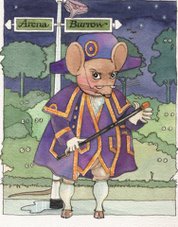
The Old Coal Road across the Wolds passes the highest railway station in England, and proceeds through glorious scenery. Savouring the wide horizons, I wondered whether my new post would be too windswept. However, the road dipped into a sheltered glade of mature trees, and there, alongside a swiftly flowing river, nestled Anticant’s Burrow – an old coaching inn with an arched gateway leading into an inner courtyard.

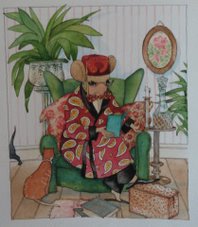
Soon I was presenting my credentials, furnished by my esteemed friend and mentor, Mr Bumble, to Judge Anticant and his sidekick Ben Trovato. Judge Anticant is a kindly though somewhat pernickety old gentleman, usually clad in a flowered dressing gown and surrounded by piles of books and several marmalade cats. Ben is a genial, jaunty young fellow who is in general charge of the establishment, and Mine Host of the Snug Bar, which is the social centre of the Burrow.

Having successfully passed their scrutiny and answered all their questions to their apparent satisfaction, I was offered the post of Burrow Beadle with responsibility for ensuring the safety and good order of the premises and its inmates and guests. I was proud to accept, and was then given a tour of the Burrow and grounds. Ben explained that, owing to its slightly off-the-beaten-track situation, the Burrow was largely spared the incursions of vulgar charabanc crowds and the type of unwanted intruder who roused the ire of John Fothergill [of An Innkeeper’s Diary fame] by enquiring the way to the lavatory, using it, and then departing without spending another penny. Also, the dining guests are generally well-behaved – unlike all of Fothergill’s, one of whom once yelled across the dining room: “Have you anything in this place fit for me to drink, Fothergill?” – to which Mine Host haughtily replied: “Poison!”.

I was then introduced to the Burrow’s resident St. Bernard, Wooffie, with whom I was destined to have many adventures, bearing life-saving brandy barrels to travellers lost on the snow-bound Wolds and even on one occasion in Northern Lapland where Santa’s reindeer had been grounded. Making my first inspection of the premises, I noted that the river bank, which formed the Burrow boundary on two sides, was vulnerable to unauthorised landings by audacious canooists and others, while the Burrow flagpole, bearing Anticant’s personal standard proudly aloft, was also adjacent to the river. A past experience as a young apprentice before the mast in a three-masted tea clipper, where I enjoyed two of the three pleasures memorably chronicled by the late Mr George Melly – lots of rum and concertina, but no bum because I was already, though still at a tender age, enamoured by the late lamented Mrs. Flarge – had commended me to Anticant and Ben, who were concerned about the incursions of a certain Naked Kayaker who apparently from time to time ignited intemperate bouts of knicker-waving in the Snug which they considered detrimental to the decorum expected by their more sedate guests, such as Dame Barbara Cartland and Miss Marple.

It was clear, from my initial interview, that I might well have my work cut out in preserving good order and decency, and as I snuggled down that first night amid the snow-white sheets I wondered whether I would have the stamina to meet the challenge of the Burrow. Only time would tell!

Tuesday, 10 July 2007

ANSWERS FOR APHRA

I’ve volunteered to answer five questions from Aphra Behn for the INTERVIEW MEME. Here are her questions, with my answers:

1. Social justice is important to you. When did you first become aware of injustice in the world and what was your response to that?

I already knew in my early ‘teens that I was 100 per cent. Gay, and that this wasn’t just a passing phase. [How did I know? I don’t know - but I did.] At that time, any physical sexual contact between males was a criminal offence, and so if one was to have any fulfilling personal life at all, one felt and had to behave as if one was a resistance fighter in enemy-occupied territory. As we were fighting a war against tyranny, and – we were told - for democracy and personal freedom, this was completely at odds with my sense of justice. [I am a Libran.] I decided, even before I went to University, that if I could I would do something to remedy this wrong. I was fortunate in realising this ambition, and my experience led me on to involvement in several other civil liberties causes.

2. You've a long life of political engagement behind you - which of your enemies or heroes have you had direct dealings with, and were they what you expected?

People are rarely what you expect, though some of them run true to form. I’ve had dealings with several of my heroes. One of them was quite the opposite of what I had imagined. This was Aubrey Jones, who had written a political tract – The Pendulum of Politics – which I greatly admired. When I encountered him as Director of a large business organisation, I found that my idol had feet of clay – he was devious and manipulative. He went on to be a Conservative Minister….

Roy Jenkins, whom I knew as Home Secretary in the 1960s, was one of the most civilized and genuine politicians I’ve known. He was really sincere in his belief in a liberal, free, ‘civilised society’ – a vision which earned him the undying hatred of Mary Whitehouse and her ‘Moral Majority’ friends [of whom it was aptly said that they were neither moral nor a majority].

Although I never met that lady personally, I had some uncomfortably close dealings and controversies with her and found her to be a most unscrupulous and on occasions untruthful debater. She stuck at nothing to smear those she disagreed with as deliberate agents of moral depravity, and refused to consider any point of view other than her own.

A hero I only met once, but shall never forget the powerful impression he made on me, was Lord Brabazon of Tara. A contemporary, friend and cabinet colleague of Winston Churchill, he was one of the most vividly robust people I’ve ever met. A pioneer motorist and aviator, and a keen practitioner of many other sports, he led an adventurous life which he chronicled in his autobiography The Brabazon Story, which is a rattling good read.

3. Looking back, if you could change just one thing about the world political stage during your lifetime, what would it be?

I would have taken the United Kingdom into the inner circle of the European Movement from the very beginning, as Churchill advocated, and ensured that we exercised our full influence in the development of the European Union. The notion that because Americans speak a bastardized form of English, and that since we have some interests in common with them from time to time, they are in some way less foreign than other countries and we have an indissoluble ‘special relationship’ with them, strikes me as complete bunkum. This fallacy has led to the foreign policy disasters of the Blair years.

4. If you were to reform education in the UK how would you do so - more specifically (if you choose) if you were to design a curriculum for modern school children, what would it include?

There are only three things every child should be taught. First, that other people are as real as you are [Shylock: [I am a Jew but] “if you prick us, do we not bleed? If you tickle us, do we not laugh? If you poison us, do we not die? And if you wrong us, shall we not revenge?” Second, never do to anyone else what you would not willingly have done to you. And thirdly, that the most important thing in life is to be kind.


These are, in my view, the root principles of moral education. All else depends on the capability of the teacher and the capacity and willingness of the pupil to learn.

Montaigne observes – sagely, as always – that parents should pay much closer attention than they usually do to their small childrens’ infant behaviour and play patterns. Innate tendencies to cruelty and dishonesty come out early in the tormenting of animals or cheating at pin games – the infant who cheats will, unless checked, grow up into the professional scam merchant. Yet many parents tacitly endorse such conduct by saying “Isn’t she cute?”

If I were designing a national curriculum, I would ensure that dubious subjects such as creationism were taught - if at all - as examples of controversial opinions which need to be weighed against alternatives. The object of education should be to teach children to think for themselves.

But it’s an uphill struggle. I shall never forget overhearing someone saying “I was at the Department of Education the other day, and a senior official said to me ‘We don’t WANT too many highly intelligent people in this country, do we? They cause too much trouble!'” Oh, dear……..

5. Talleyrand - libertarian or opportunist? (Or any poacher- turned-gamekeeper of your choice).

How clever of you to guess that Talleyrand is one of the characters in history I would most like to meet! I first encountered him as a child in Rudyard Kipling’s Rewards and Fairies stories “Brother Square-Toes” and “A Priest in Spite of Himself”. The more I’ve read about him, the more I admire him. Far from being the self-interested turncoat he has been depicted as by some French historians, he was – while naturally concerned about self-preservation – utterly consistent in his pursuit of peace, moderation and civil liberty both at home and in foreign policy. An Anglophile, he believed that the key to France’s prosperity and a peaceful Europe lay in Anglo-French friendship. His latest biographer – David Lawday – calls his book Napoleon’s Master, and Talleyrand certainly stood up to and ultimately outmanoeuvred the Emperor and then went on to curb the stupider excesses of the Bourbon ‘Ultras’ during the Restoration.

Apart from his political wisdom, he was a witty, cultivated and often charming survivor of the Ancien Regime. He even won over the prudish Fanny Burney! I certainly wish Hendrik Van Loon had included him as a dinner guest in his fascinating Lives.


DIRECTIONS FOR THE INTERVIEW MEME

  1. Leave a comment saying, “Interview me.”
  2. I will respond by emailing you five questions. Please make sure I have your email address.
  3. You will update your blog with the answers to the questions.
  4. You will include this explanation and offer to interview someone else in the same post.
  5. When others comment, asking to be interviewed, you will ask them five questions.

HELL FREEZING OVER?

ben trovato says "I've shamelessly pinched this from Kit's blog as I haven't laughed so much for a while either":

I read this on Ryze.com when I was dutifully networking this morning. It gave our muscles such a great workout, with the gasping and spluttering with laughter that I thought I should share it with you:

The following is an actual question given on a University of Washington Chemistry mid-term.

The answer by one student was so "profound" that the professor shared it with colleagues, via the Internet, which is, of course, why we now have the pleasure of enjoying it as well:

Bonus Question: Is Hell exothermic (gives off heat) or endothermic (absorbs heat)?

Most of the students wrote proofs of their beliefs using Boyle's Law (gas cools when it expands and heats when it is compressed) or some variant.

One student, however, wrote the following:

First, we need to know how the mass of Hell is changing in time. So we need to know the rate at which souls are moving into Hell and the rate at which they are leaving. I think that we can safely assume that once a soul gets to Hell, it will not leave. Therefore, no souls are leaving.

As for how many souls are entering Hell, let's look at the different religions that exist in the world today. Most of these religions state that if you are not a member of their religion, you will go to Hell.

Since there is more than one of these religions and since people do not belong to more than one religion, we can project that all souls go to Hell. With birth and death rates as they are, we can expect the number of souls in Hell to increase exponentially. Now, we look at the rate of change of the volume in Hell because Boyle's Law states that in order for the temperature and pressure in Hell to stay the same, the volume of Hell has to expand proportionately as souls are added.

This gives two possibilities:

1. If Hell is expanding at a slower rate than the rate at which souls enter Hell, then the temperature and pressure in Hell will increase until all Hell breaks loose.

2. If Hell is expanding at a rate faster than the increase of souls in Hell, then the temperature and pressure will drop until Hell freezes over.

So which is it?

If we accept the postulate given to me by Teresa during my Freshman year that, "It will be a cold day in Hell before I sleep with you," and take into account the fact that I slept with her last night, then number two must be true, and thus I am sure that Hell is exothermic and has already frozen over. The corollary of this theory is that since Hell has frozen over, it follows that it is not accepting any more souls and is therefore, extinct......leaving only Heaven, thereby proving the existence of a divine being which explains why, last night, Teresa kept shouting "Oh my God."

THIS STUDENT RECEIVED THE ONLY "A"

Monday, 9 July 2007

A SAD DAY!

Yellow Duck has deleted the Duck Pond from the blogosphere!

Now we don't even have the nostalgic pleasure of revisiting those reedy mellow shores - an oasis of wit and wisdom.

No doubt he has his reasons, so I won't blame him though I think he is rather a meanie.

Friday, 6 July 2007

THE BEADLE SAYS NO.

After watching this, the Beadle has decided not to apply for a post as a big game warden in Africa. He feels safer patrolling the burrow boundaries, naked kayakers and all.

Wednesday, 4 July 2007

$27 MILLION LUNACY

Don't miss the new link I've just posted in the arena. Minds are not required, but if you have one it will boggle.

Tuesday, 3 July 2007

A GLIMPSE OF THE FUTURE?

anticant writes:

I returned home yesterday after a week as an inpatient in my local Marie Curie Hospice. I went there because the previous week I had an investigative ‘procedure’ at the nearby hospital which left me with a bladder infection – so much for the vaunted NHS clean-up of hospital bugs! I felt so poorly and washed out the following weekend that I knew I needed a few days’ nursing care. So I phoned the hospice – whIch I visit most weeks as a day patient – and asked whether they could take me in. Within the hour, they replied saying “yes – come along”. So I have spent the last week being dosed with antibiotics and recovering from my painful condition in unexpectedly pleasant surroundings.

Not having been an inpatient before, I was unsure as to how the hospice would compare with the several hospitals where I have been a patient over the past couple of years. I need not have worried – there is no comparison. The hospice is staffed by highly skilled and genuinely friendly staff, and equipped to a standard that you don’t find in most other medical establishments. It’s like a hotel with nursing; there are comfortable sitting rooms for patients who can walk about and their families, and a [highly alcoholic] free drinks trolley, provided by the Friends of the hospice, comes around most days – so I was able to celebrate the departure of the ghastly Blair with a large brandy!

Routine and discipline are at a minimum, and necessary tasks such as washing and the administration of medicines are carried out in a friendly, informal way. Nothing is too much trouble for the staff, who are dedicated to making life as comfortable as possible for patients however ill they are. Of course, there is a sad side in that many of the patients are extremely ill and indeed dying – there was at least one death while I was there. But I cannot imagine a more supportive, friendly, and indeed cheerful, place in which to be terminally ill and to die, and I hope that it will be my last port of call in due course.

Marie Curie Cancer Care is a charity heavily dependent on voluntary funding, and I earnestly commend it to all my blogging friends who want to donate to a charity that they can be assured will use their money wisely and well.

I’m pleased to say that after my week’s ‘rest’ I feel much better and ready to resume the threads of what’s left of my life. I also feel much more secure about the future.